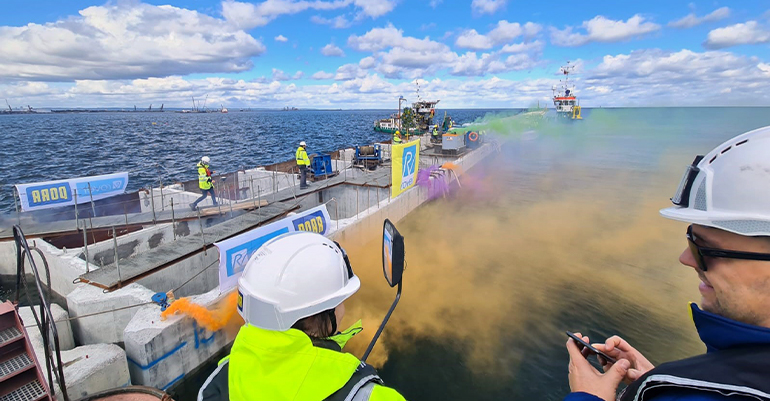
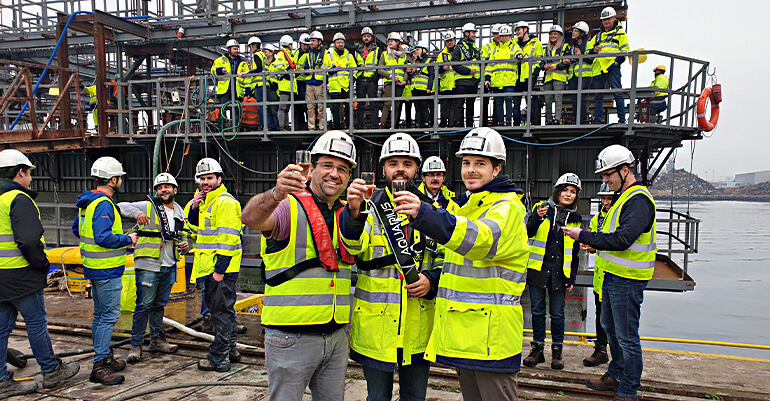
38 drawers in 300 days and 300 nights
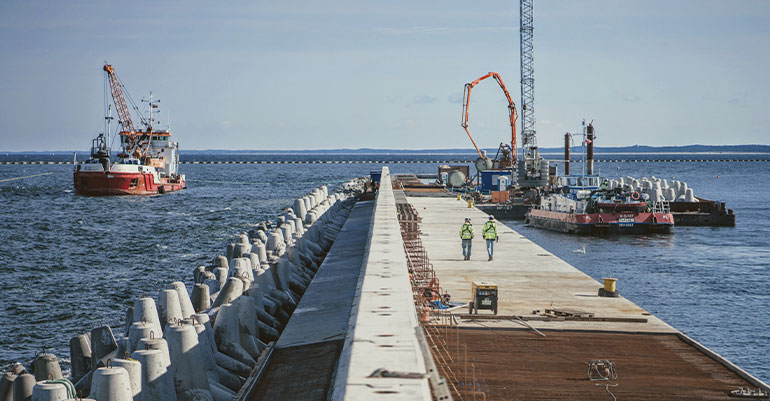
It has taken 10 months, with all their days and nights, working 24 hours a day from Monday to Sunday, to complete the manufacture of the 38 floating boxes of reinforced concrete that already form part of the new shelters of the port of Gdańsk.
More than two kilometers long, form the new zone of sheltered waters, thus improving the operation of the port and in particular the container terminal, in its current and future configuration, that, following its next expansion, it will become one of the largest Baltic Sea container terminals.
The projected dikes of mixed type are formed by a drawer on the inner side, on which supports an embankment of dampers and tetrapods that forms the protection on their sea side. The design of the dike has been carried out taking advantage of previous experiences in the development of the patent, of anti-reflective drawers, “No Waves” by Rover Maritime. In this way, large windows have been created on the outer and inner walls of the drawer that allow to decrease the reflection of the incident wave inside the dock.
The floating cabinets of reinforced concrete, are a constructive typology widely used in the Mediterranean, being Spain pioneer in its development and place where it has acquired a high specialization in recent decades, only comparable with that of Japan. Currently this technology has been imported and extended to several countries where customers have discovered the technical, economic and time-saving advantages of this constructive solution. This is the case of Poland.
The decided bet, since the bidding phase, for the use of crates, has allowed the Rover Group to be awarded one of the most important maritime works contracts, in technical and economic terms, of Northern Europe.
For the execution of these crates, Rover Maritime towed its drawer dike the more than 2200 miles that separate the Bay of Algeciras from the Port of Gdansk.