Artificial Reefs
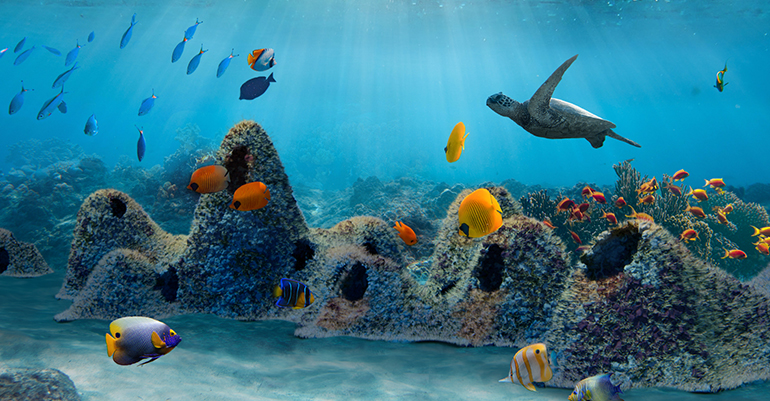
This pioneering project reduces its manufacturing carbon footprint by 30% compared to the standard, doubles CO2 fixation on the seabed and promotes the proliferation of native marine fauna
Rover Group has developed and led the research project “Living Ports: Maritime infrastructures of sustainable concrete to promote the growth of marine flora and fauna” which, together with the Polytechnic University of Valencia, the Catholic University of Valencia and with the support of the Valencian Innovation Agency, has managed to obtain artificial reefs from a concrete that reduces its carbon footprint by up to 30% compared to standard, double the fixation of CO2 on the seabed and promote the proliferation of marine fauna with an environmentally compatible design.
Concrete-based coastal and maritime infrastructure, so necessary for the economic development of our society, is placed in natural habitats that can alter existing marine flora and fauna.
To minimize these effects, in the pioneering project Living Ports “a technology has been developed to adapt these maritime-port infrastructures to natural environments and climate change, since one of its consequences is the constant erosion and retreat of sand on our coasts,” points out Alfredo Rodríguez, president of Rover.
Its design has materialized with two complementary objectives, as noted by Lisardo Fort, responsible for R&D of Rover, “on the one hand, reducing the carbon footprint by using recycled materials and, on the other hand, the ability to promote the growth of marine flora and fauna through innovative design.”
A new concept for coastal protection infrastructure.
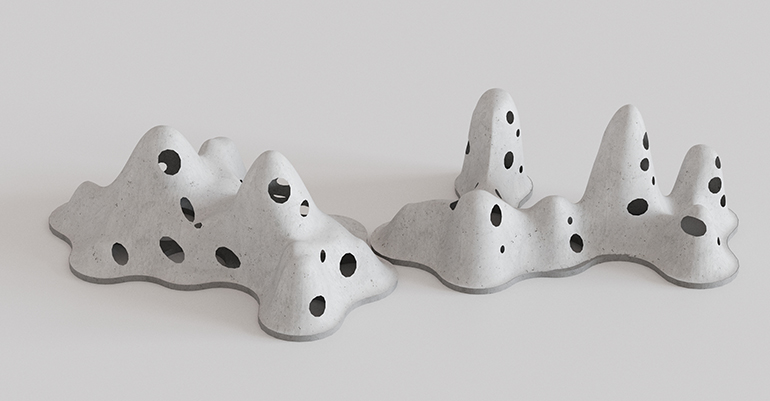
Thus, the new sustainable concept for these port shelter or coastal protection infrastructure is based on the formulation of a concrete matrix with a reduced carbon footprint, that maintains the same or better technical performance as a standard concrete and in design with a series of modifications at the micro-surface and macro-structural level, to increase the proliferation capacity of native species.
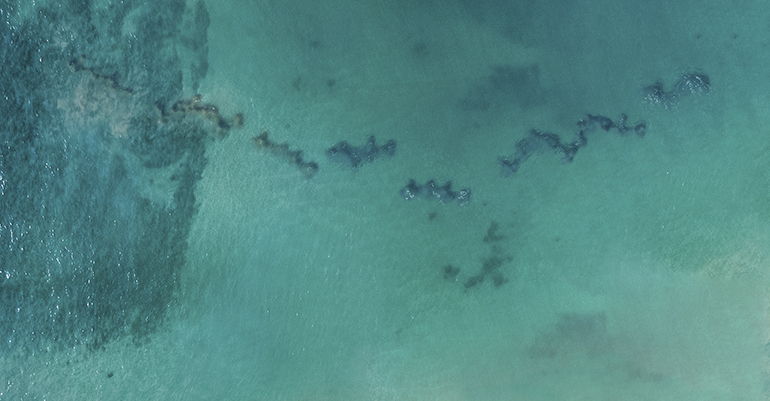
After initial tests in the laboratory, a series of prototypes with different material composition, different designs (vertical wall and pyramid) and with different functionalities were manufactured to represent various maritime or port applications. These prototypes, installed at the Port of Sagunto, are monitored by Rover Maritime’s submarine ROV (unmanned underwater robot) systems, which conduct dives on a regular basis.
The main results obtained to date include a reduction of up to 30% in its carbon footprint compared to the standard, and the creation of a material binary systemdesign that nearly doubles the fixation of CO2 on the seabed and the achievement of a design that promotes the proliferation of local fauna.
Extrapolating these results to an example, such as the application as coastal protection of a beach like Pinedo (Valencia), these sustainable structures, with protective function, would additionally fix more than 1,5 tons of CO2 in the first cycle of local seaweed settlement alone.
The project was recently presented by Rover in Altea during the ‘Innovation for Sustainability of the Coast against Climate Change’ event, which brought together more than 600 professionals from the public and private sectors.