Concession of the SMART RAIL project
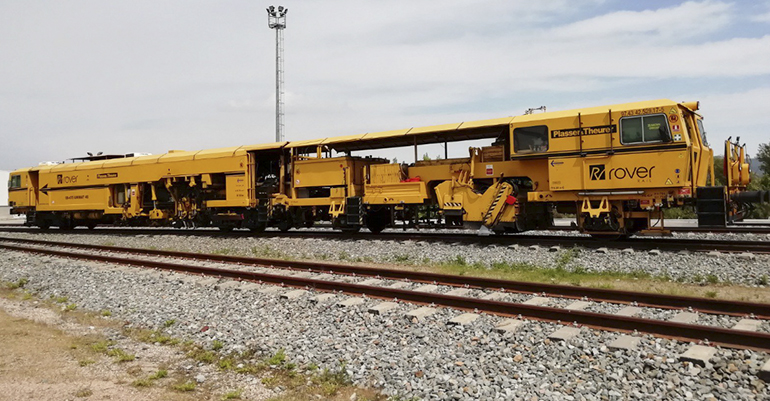
IVACE has recently granted support for the implementation of the SMART RAIL project: “ANALYSIS MACHINE LEARNING ON GEOPHYSICAL MASS COLLECTION DATA WITH MULTIARRAY TECHNOLOGY FOR INTELLIGENT MAINTENANCE OF RAILWAY INFRASTRUCTURE” within the PIDCOP-programmeCV R&D projects in COOPERATION from 2023 with the participation of Geozone Asesores S.L.
The main objective of the project is the implementation of an advanced geophysical exploration system of the railway substructure using non-invasive georradar techniques, based on machine learning processing of large data sets for the analysis of ballast contamination degree. For this, a data collection system with multiarray GPR+GPS+VIS technology will be implemented in railway maintenance machine, for the subsequent processing of complex and massive sets of geophysical data collected on the track. The purpose is to detect anomalies in the compactness of the ballast, its degree of contamination and pathologies or subsidences that may be found on the subplatform.
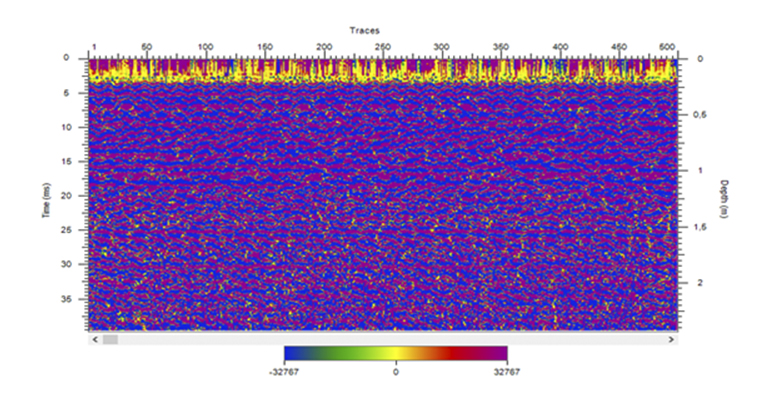
This will be done from the graphical and numerical correlation of possible patterns in the data related to the state of the track sections analyzed, for their implementation in predictive maintenance work. In this way, it is possible to alert areas of the track susceptible to local intervention at incipient stages, to anticipate the appearance of pathologies and high levels of deterioration during their useful life cycle.
A radar chart is an averaged image of the set of traces and GPR profiles obtained by reflection in the georradar.
Allows for the detection of anomalies such as possible subsidences in the ballast/subalastus assembly, but not their degree of contamination. For this reason, new Big Data techniques (such as principal component analysis and cluster analysis) will be employed to analyze the data corresponding to GPR profiles detected by georradar. The multiarray technology has 32 antennas, 23 with polarization in the direction of the march and 9 with polarization in the direction of the transverse, which allows to analyze in each take 32 data matrices of the order of 20,000 observations for 500 variables.
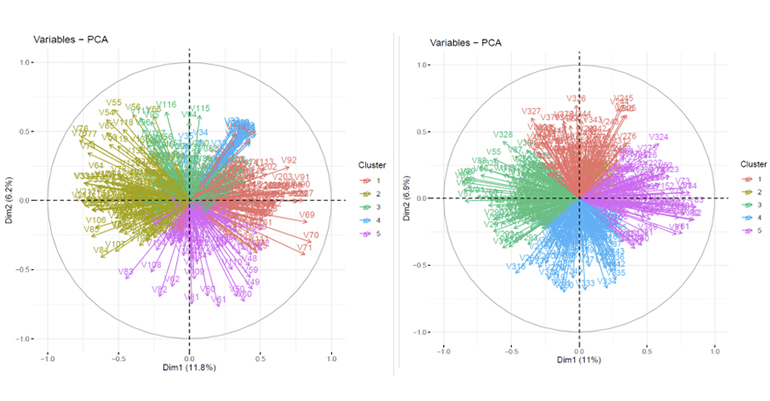
When the ballast does not exhibit contaminants, an orthogonal pattern is observed when projecting variables over the space of the main components (axes of ordering and abscissis); in addition, this begins to manifest at an intermediate stage of contamination, which would make it possible to alert in incipient stages for the implementation of predictive maintenance. The competitive advantage of the application of these techniques is that they allow to summarize many data difficult to interpret, in a new variable called main components, which are obtained as linear combinations of the originals, without the inconvenience of having to delete any others that might be throwing out relevant information about the problem.
The project is scheduled to end in October 2024.