Eco-concrete with glass residues and environmental certificate
Innovation is one of the strategic pillars of Rover Group, and its commitment to R&D&I translates into the drive for advanced and innovative solutions that transform the construction sector. In this line, Rover Maritime, a subsidiary specializing in marine infrastructure, has developed a new sustainable eco-concrete. An innovative component resulting from the company’s commitment to the circular economy and the reduction of carbon footprint in construction materials.
This new material has been developed within the framework of the Living Ports project, led by Rover Maritime and supported by the Valencian Innovation Agency within the program of Strategic Projects in Cooperation. The project aims to adapt maritime and port infrastructure to climate change through sustainable solutions that reduce greenhouse gas (GHG) emissions and promote marine biodiversity.

A concrete that cares for the planet
Most of the CO emissions associated with concrete manufacturing come from the production of Portland cement, which accounts for 85-90% of the material’s carbon footprint. To reduce this impact, Rover Maritime has incorporated recycled glass waste into the composition of the Eco-Concrete by decreasing the amount of cement needed, as well as preventing these wastes from ending up in landfills.
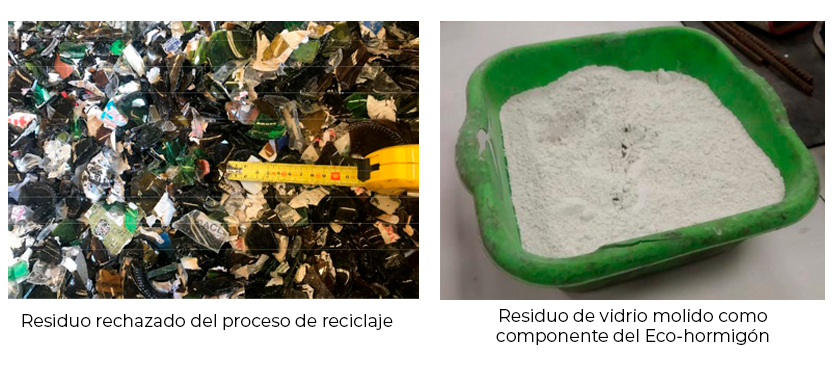
The glass used comes from rejecting glass with impurities from the conventional recycling process. This residue is milled to obtain a glass powder with the ability to react puzolanically, which allows to partially replace the Portland cement and part of the fine aggregate in the concrete mixture.
Significant emission reductions
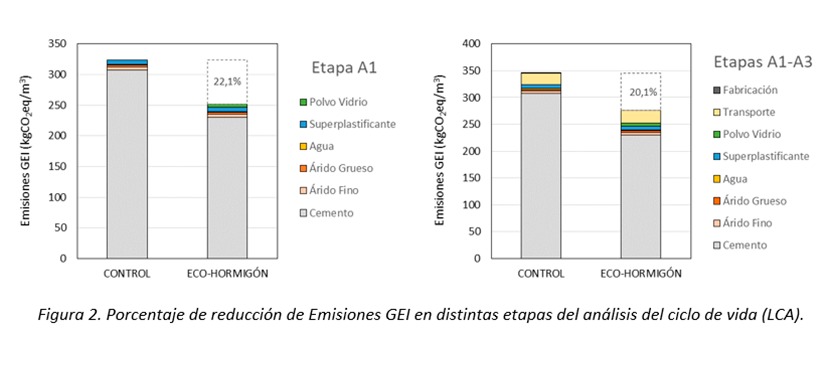
Tests have shown that 8% of the total weight of concrete is replaced by glass powder, resulting in a 21% reduction of CO emissions at stage A1 (raw materials) compared to traditional concrete. If we also consider stages A2 (transport) and A3 (manufacturing), the total greenhouse gas (GHG) reduction is 20.1%.
This emission saving is especially relevant in maritime works, where the volume of concrete used is high. In addition, Eco-Concrete maintains physical properties compatible with its structural use, making it a viable and sustainable alternative.
Obtaining the product’s environmental certificate
To validate the environmental benefits of the new material, Rover Maritime has developed a partial Product Carbon Footprint (HCP) Technical Study of Eco-Concrete. This study includes a comprehensive Life Cycle Analysis (LCA) from cradle to gate, as well as the calculation of the Carbon Footprint of Eco-Sustainable Concrete compared with traditional concrete, covering stages A1, A2 and A3 of the production process.
The report has been audited and certified by Kaizen Audit and Certification, which has issued the favorable Type II Product Self-Declaration Environmental Declaration Certificate. This certificate officially recognizes the environmental advantages of Eco-Concrete developed by the Rover Maritime team.