Living Ports Project’s Prototypes’s Instalation
The Valencian Innovation Agency awarded Rover Maritime S.L. in 2020 a grant for the execution of the project “Living Ports: Sustainable concrete marine infrastructures to promote the growth of marine flora and fauna” within the 2020 Strategic Projects in Cooperation program. The company has developed the project during the period 2020-2021 jointly with the Polytechnic University of Valencia and the Catholic University of Valencia, for which they have had a total budget of about 500,000 €.
Concrete-based coastal and maritime infrastructure (MCI) dominates coastal areas around the world, these infrastructures that replace or invade natural habitats can provide an ecosystem similar to that offered by undisturbed coastlines. Still, studies show that marine flora and fauna in ICM zones is less diverse than in natural ecosystems, and is commonly dominated by opportunistic and even invasive species.
To minimize these effects, the LIVING PORTS project proposed the adaptation of port maritime infrastructures to climate change by demonstrating and implementing sustainable solutions, able to reduce the carbon footprint by using recycled materials and their ability to promote the growth of marine flora and fauna on its surface thanks to an innovative design. The new sustainable concept for these port shelter infrastructures has been based on a concrete matrix with a reduced carbon footprint thanks to the incorporation of recycled glass that helps to significantly reduce the amount of Portland cement, which is primarily responsible for the carbon footprint associated with concrete.
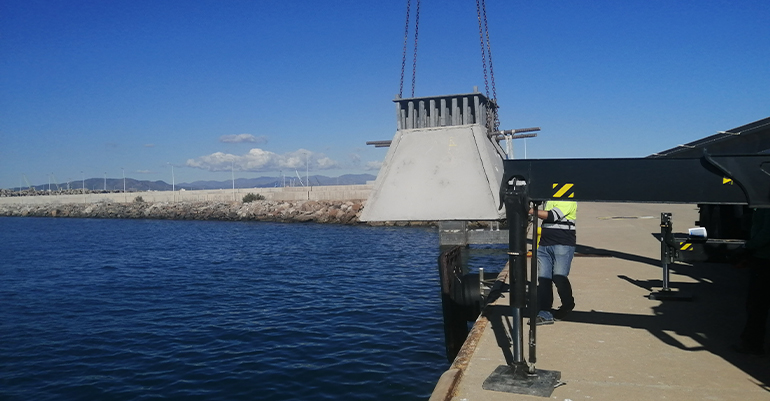
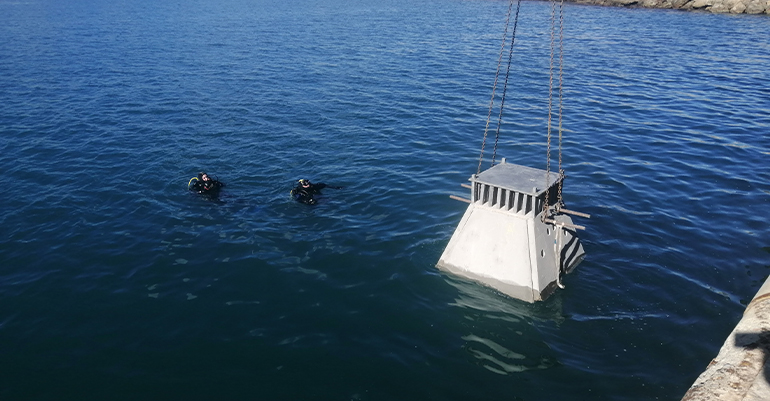
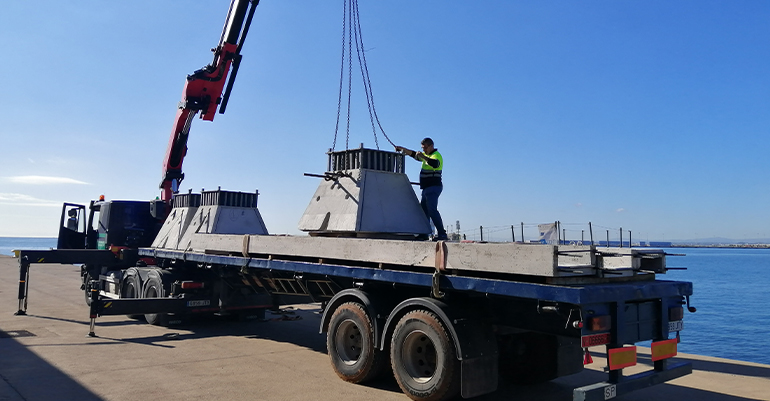
To validate the concept, a series of prototypes were designed and installed in the Port of Sagunto to monitor the settlement and growth of the native flora and fauna of the area.
The prototype elements consisted of a series of vertical concrete plates resting on the wall of the dock as a prototype of an outer wall of box springs and another series of pyramid blocks placed on the seabed as a prototype of artificial reef units. In both cases, concrete was made with two different proportions of recycled glass together with a control element based on ordinary concrete. In all the pieces, different macrodesigns (tunnels, holes of different diameters and depth) and microdesign with different levels of surface roughness were applied to the surface in different zones of each of the elements.
Once the prototypes are installed, they are being monitored through different monitoring campaigns by visual inspection of the area, with underwater drones or divers, and taking samples for species characterization. The first monitoring results will be available in 2022.