Project OPTIM-HC: Artificial Intelligence applied to the minimization of carbon footprint in large linear works
The OPTIM-HC project “ARTIFICIAL INTELLIGENCE APPLIED TO MINIMIZATION OF CARBON FOOTPRINT IN LARGE LINEAR WORKS” led by Rover Infrastructures, is part of the program of Consolidation of the Business Value Chain of the Valencian Institute for Competitiveness and Innovation (IVACE+i), co-financed by the European Union within the framework of the Valencian Community ERDF program and develops a dynamic algorithm to reduce the carbon footprint in the execution of major civil works, such as roads or high-speed train lines.

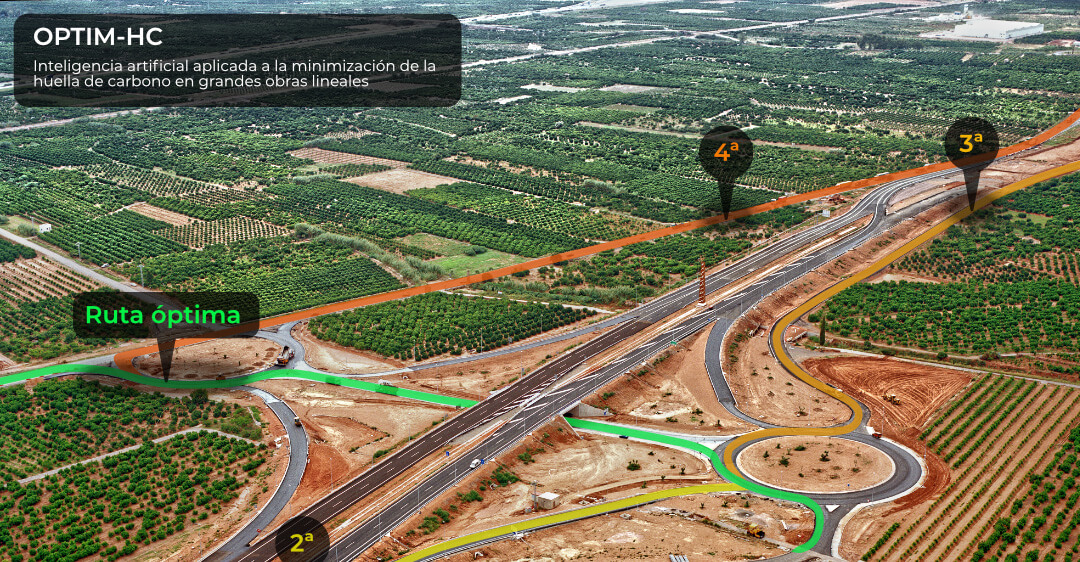
This computer model, based on Artificial Intelligence, is able to optimize the material transport routes and machinery required to build these infrastructures by identifying the best routes. This is intended to reduce the gaseous and particulate emissions associated with these operations.
The initiative represents a change of focus in process improvement of a sector that now, more than ever, takes into account the energy cost in actions aimed at improving its sustainability. This innovative project also stands out for being the first tool of its kind on the market.
The tool developed by Rover starts from the virtualization of large works transport activities to obtain a dynamic mathematical model of these operations. It is in a second phase when optimization algorithms are applied, which determine the best route among all possible ones. One of the main advantages of this technology is that it generates a dynamic model, which considers the temporal evolution of construction activities. That is, the system analyzes the situation of the environment in which the works are carried out, including the state of existing communication routes, technical characteristics and changes in access.
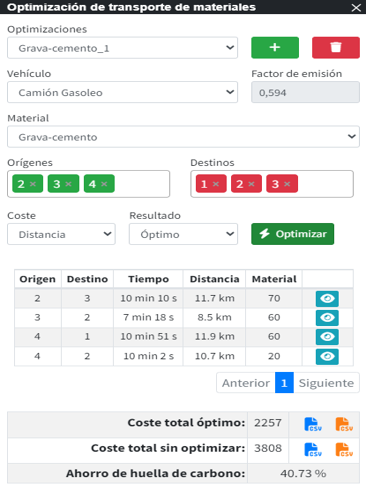
In the last phase of the project, the tool has been validated in large linear works on railway lines and roads, executed by Rover, conducting pilot tests on real use cases, to obtain a metric of the percentage of savings in pollutant emissions after implementing optimal solutions. , achieving a final reduction of emissions close to 40% in some cases.