OPTIM-HC Project
The project, framed in the 2022 Consolidation of the Business Value Chain program, is scheduled to end in September 2024 and has a total budget of about €400,000. For its implementation, it will be supported by the University of Castilla La Mancha.
GOAL & MOTIVATION
The activity generated by the construction sector is the largest consumer of natural resources. Globally, civil engineering and building construction consume 60% of the raw materials extracted from the lithosphere. Of this volume, construction accounts for 40%. In the European Union, building construction consumes 40% of all materials, and per capita mineral extraction amounts to 4.8 tons per person per year, uses 40% of primary energy and generates 40% of waste, having special responsibility in the current deterioration of the environment the expansion of the built park.
Some years ago, energy costs did not play a decisive role in the execution of a project and, as a result, improving the profitability of this project was not focused on reducing or optimizing consumption, but now the context has changed radically and it is necessary to do so for both environmental and economic issues.
To combat and prevent the reduction of environmental impact within this area, it is necessary to consider three fundamental aspects:
- The reduction of polluting emissions.
- Controlling resource consumption
- The minimization and proper management of waste generated throughout the construction process
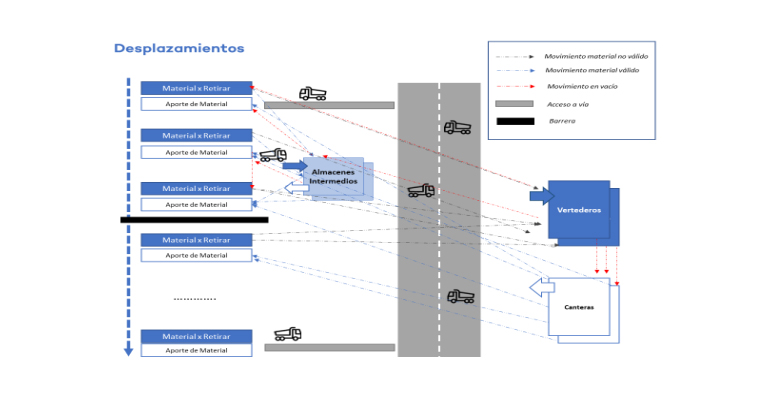
It is precisely in this last aspect that will be influenced by the execution of this project, which aims to design a software tool that allows the reduction of the environmental impact of civil VR works with the implementation of AI algorithms for the Optimization of the routes of the means of transport that minimize the carbon footprint associated with the transportation of materials on the construction site. To this end, a carbon footprint calculator will be developed that allows the study to quantify an estimate of the environmental impact of civil VR works.
To this end, the necessary IT tools will be developed to quantify the environmental impact of works with a metric of the generated carbon footprint, the study of reducing this impact by implementing optimization algorithms that minimize it and data mining techniques, which in a context of analysis and management of massive and complex amounts of data could not be processed by traditional techniques.
WORK PLAN
For the development of the project three main phases have been proposed:
- Validation of the Artificial Intelligence tool in real environments and carbon footprint minimization calculation
- Previous studies and design of the AI tool
- Development of the modeling tool with Artificial Intelligence