Puertos del Estado will finance the innovation project NoWaves of Rover Maritime in the Port of Valencia
- A full scale pilot project will be designed and implemented
- Rover’s patented technology to minimize the effects of the waves is selected with the third best score in the R&D Ports 4.0 call
- Rover is the first construction company to be awarded a project in the commercial phase in this call
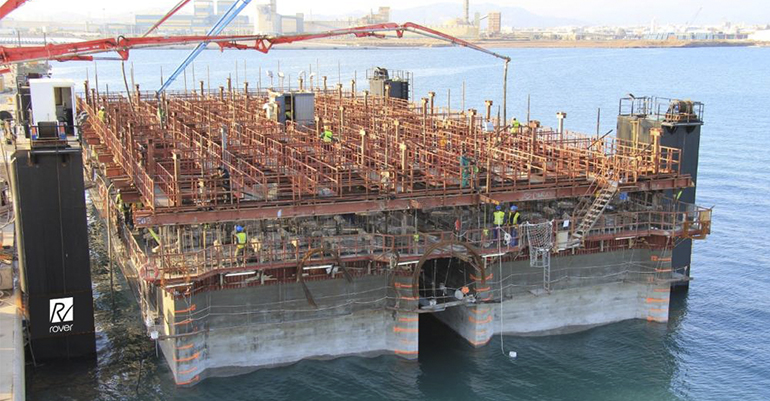
Puertos del Estado, through its call for R&D projects Ports 4.0, has selected the NoWaves project, patented by Rover Maritime, to finance the design and construction of a pilot in real scale at the facilities of the Port Authority of Valencia. The NoWaves technology minimizes the effects of waves on port docks by building concrete crates with various paths inside them, where the waves circulate and dissipate (rather than bounce back).
The project, which has been supported by the Port Authority of Valencia as a facilitator agent, has achieved the third best score among the 43 proposals submitted to this call, where Rover is also the first construction company to be awarded a project in the commercial phase.
The NoWaves technology has already been developed and verified in various R&D projects in laboratories of universities and recognized public research centers. Now, in this last phase, a full-scale pilot (about 45 meters long) will be built to test it under real operating conditions. In addition, the project aims to transform the classic “passive” port infrastructures into active elements by adding mobile sluices to the standard construction system of reinforced concrete crates, that react dynamically to the existing wave conditions of the port at any given moment and manage to dissipate the wave. All, to help reduce the level of agitation in their docks, thus facilitating loading and unloading operations, as well as keeping the port operational longer in temporary conditions.
In this way, NoWaves will develop the technology that will allow to build more competitive and safe port infrastructures in their operation, as well as their adaptation to the effects of climate change.