Rover Maritime promotes in Altea a pioneering day on the coast
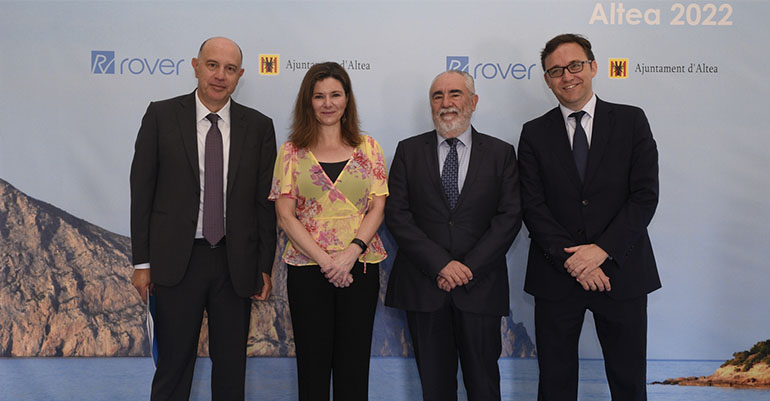
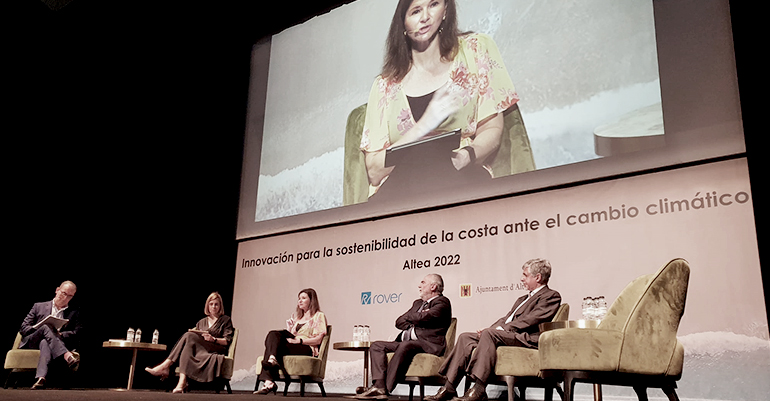
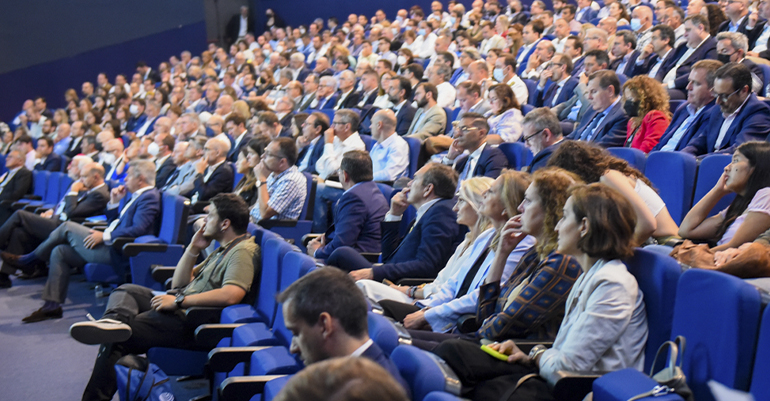
With the aim of increasing the resilience of the Spanish coast against the adverse effects of climate change, Rover Maritime has celebrated today in Altea (Alicante) the I Innovation Day for Sustainability on the Coast against Climate Change. The meeting, which has been attended by more than 600 attendees, has brought together leading national and international experts from various disciplines, as well as prominent members of central governments, autonomous and local around the challenges and opportunities that innovation offers for the planning and management of the coastline.
Jaume Llinares, Mayor of Altea, has made clear in his welcome speech that climate change “can only be tackled if we work together. The future of the planet requires the commitment of all, governments and private enterprise. The sum of efforts is key.”
For his part, Alfredo Rodríguez, President of Rover Group, has acknowledged that all those present at the event “are moved by the desire to leave a better planet for future generations.” In addition, it has taken the opportunity to announce that Rover Grupo wants to concentrate the Altea several departments of the company such as innovation, among others.
“Engineers and innovation have always been at the service of society and progress,” he said, adding that today society “has given us a clear mandate: to fight climate change and for environmental sustainability.” Finally, he has taken the opportunity to announce that a very exciting project of the company is underway, such as the creation of artificial reefs from sustainable concrete.
The protection of the coast from the effects of climate change is one of the pillars of the National Plan for Adaptation to Climate Change, a challenge that transcends a large number of actors involved, especially administrations and business sector.
Protecting our ports and coasts.
This has been highlighted by the participants of the first of the tables “Ports and Coasts. Experiences with Climate Change”. Among them María Luisa Martínez, director general of Ports, Airports and Coasts of the Valencian Generalitat, who has not hesitated to qualify the Mediterranean as “zone 0 of climate change”, stressing that all the actions of her administration “they are aimed at interadministrative coloring at all times without, of course, forgetting the public-private one”. “We need innovative and environmentally friendly solutions, always seeking balance between port infrastructures and the coexistence of citizens” he emphasized.
For her part, María José Rallo del Olmo, secretary general of Transport and Mobility. Ministry of Transport, Mobility and Urban Agenda, has emphasized that “the fight against climate change is the great challenge of humanity of the twenty-first century”. In his view, therefore, action is needed on two fronts: mitigation by reducing greenhouse gases and adaptation to a change “that is already here and to which one cannot turn its back. The great lever to act against this is innovation,’ he added.
The Port of Valencia has been the chosen reference point to talk about an exemplary infrastructure. Francesc Sánchez, director general of the Port Authority of Valencia, has shown that already in the 90s “the port of Valencia put in place a policy of environmental protection. We have been proactive and pioneering in promoting environmentally sustainable projects and practices and are the first port to measure carbon footprint. We have demonstrated, beyond doubt, that growth can be achieved by reducing the carbon footprint, and our next challenge is to achieve net-zero emissions by 2030.”
The scientific rigor on the table has been present by the hand of José Camacho, Scientific Officer of the World Meteorological Organization, who recalled how “the rise of the sea has accelerated in recent years as a result of climate change”. In addition to reviewing the extreme wave and coastal wind phenomena that have been happening in recent years “These kinds of phenomena are already a reality and projections say that there will be storms of great impact, as well as frequent and prolonged droughts alternating with intense rainfall.”
Innovation to promote maritime sustainability.
On the topic of “Maritime Sustainability, Innovation and Research” have intervened, among others, José Orozco, councillor of Urbanism of Altea. Orozco has started this table explaining the Altea Zero Emissions project that operates in areas such as energy, sustainable urban mobility and the protection of natural spaces with an emphasis on the protection of the coast of Altea, of high environmental interest and also subject to the presence of numerous pleasure craft.
For his part, José Capilla, Rector of the Polytechnic University of Valencia, has championed the research role of universities, highlighting the specific training offer of this center so that students come out with the necessary tools to face the protection of sustainability “as rector I have set myself the challenge of being zero emissions in 2030” he added.
Francisco Esteban, President of the PIANC, has pointed out that his organization brings together the best international experts to address sustainable shipping challenges. He has also recalled the important research activity and publication of various publications on climate change. “we have the ability to call upon the best specialists in the world who selflessly devote their efforts to this cause.”
Lisardo Fort, R&D Director of Rover Group, has highlighted the company’s innovative character since its creation. In the area of sustainability and climate change, the firm concentrates its R&D development around 3 main areas: adaptation to climate change, design of sustainable high-performance materials and development of renewable energy integration. Fort has shown that all its developments are carried out with technological centers, universities and public administrations.
The R&D Director of Rover Group has focused on explaining an innovative artificial marine reef creation project developed by Rover. “In the face of the constant erosion and setbacks of the sand on our coasts caused by climate change, our beaches are undergoing major changes” he recalled.
To combat this, Rover has looked at how nature protects the coasts to develop and design ecological concrete structures that, once submerged in beaches, protect them from coastal phenomena and generate a respectful and ecological marine habitat. “These artificial reefs developed by Rover will be in the future a place of undoubted tourist interest since around them an important marine ecosystem of great value will develop.”
Gastronomy, AI and European finance.
The conference continued with reflections on “Dissemination, Financing and Success Cases”. The sustainable chef, Quique Dacosta, has emphasized the fact that doing the reflection as a cook from the perspective of sustainability “is already something innovative, obviously I can not attack the environment because it is what I supply”. So how does your restaurant approach innovation? “Researching and exploring with new paths and new products not so well known in haute cuisine,” he explained.
For his part, Enrique Verdeguer, Brussels Next Generation Funds Coordinator Advisor, has focused on the role of Europe and the sustainability of the EU “if we do nothing the model will no longer be sustainable. We need to bet on innovative formulas if we want to be. The green transition is, without doubt, the union’s big bet with its 2030 targets.”
Verdeguer has remarked that the Next Generation funds are associated with this transition “with which Europe wants to maintain its leadership.” Finally, he has compiled three key sustainability challenges: setting global rules of the game, defining governance and questioning sustainability. “we are undoubtedly finishing a model, but we do not know very well where we are going; the important thing is that the new one is devoid of ideologies.”
Andrés Pedreño, Professor of Economics, expert in Artificial Intelligence, has started his intervention by pointing out the need for “establish as a priority in Spain Artificial Intelligence, a technology with a great impact in all areas and called to change many productive systems”. Our country must find its own path of development in the field of AI “for example, if we can automate our ports that will give us very important information to work on the fight against climate change.”
In terms of regional policy, Paula Tuzón, the regional secretary for climate emergency and ecological transition, has emphasized that today “We have the planet more monitored than ever, so we play the best cards to set in motion the transformations needed to protect the environment.” “We are at the technologically and politically optimal moment to fight climate change.” Tuzón concluded that it is fundamental “to understand the vulnerability of our coast so that we can protect it” adding that environmental literacy of citizens is necessary.
Jaime Hermida, manager of global financing solutions at CaixaBank, has pointed out that sustainability “is not something that is fashionable, but it came from a long time ago” and added that companies have become aware of its impact on society. In the case of CaixaBank, the entity is obliged to mitigate the climate impact of its actions, which is why its new strategic plan has a pillar focused on sustainability that sets out ambitious tangible objectives.
Virginijus Sinkevicius, EU Commissioner for the Environment, Oceans and Fisheries, closed the day with a message that the EU takes the protection of the marine environment very seriously and has therefore drawn up a specific agenda to do so. “I have no doubt that ports will play a key role in the ecological transition,” he said, “and we must have good planning of the maritime environment so that its protection coexists with economic development.”
María Pérez, regional secretary of Public Works, Transport and Sustainable Mobility of the Valencian Generalitat, has been in charge of closing the day highlighting that, currently, “we face the challenge of valuing our coastline while safeguarding it from the negative effects of climate change.” To that end, “innovation and research are the only way to develop coastal and beach protection solutions, decarbonize our economy, and protect us against climate change,” he concluded.
The conference was organized with the collaboration of the Altea City Council and the support of the CONEXUS Business Foundation.