Follow-up to the “Living Reefs” project
The Living Reefs project “ECOHORMIGÓN PARA ARRECIFES ARTIFICIALES Y OTRAS INFRAESTRUCTURAS MARÍTIMAS” by Rover Maritime is part of the 2022 Strategic Cooperation Projects program of the Valencian Innovation Agency.
The project is scheduled to end in September 2024 and has a total budget of around €700,000. IMEDMAR from the Catholic University of Valencia, ICITECH from the Polytechnic University of Valencia are involved. the Department of Engineering Mecànica and Construction of the Jaume I University of Castellón and Advanced Engineering of Maritime Works INGEOMAR, as well as Rover Maritime.
This project continues the line of work started with the Living Ports project, also funded by the Valencian Innovation Agency in 2020, focused on the development of sustainable concrete. specially designed for use in maritime port infrastructure because of their ability to promote the settlement and growth of marine species and thus transform port infrastructure from an inhospitable area with little variety of species to a high-wealth area biological and fully integrated into the natural environment.
GOAL
The main objective of LIVING REEFS is the development and validation of an eco-concrete, or sustainable concrete with a dual approach. On the one hand, it is a concrete based on the use of agricultural or industrial by-products and natural materials with management needs. In this way, the variation in its composition will decrease its carbon footprint. Moreover, it is a concrete enriched with functional nutrients and bacteria to improve the colonization process during its service time by the marine species present.
INNOVATIVE COMPONENTCOMPONENTE INNOVADORA
In the development of the project, the feasibility of reusing an agricultural by-product such as rice straw that is produced in large quantities in the Valencian Community and for which currently there are no alternatives to reuse will be explored. Another source waste that will also be studied in the project are the ashes of the volcano Cumbre Vieja in La Palma (CVLP), available right now in large quantities.
The maritime infrastructures proposed in the project will be designed according to the macro design criteria (holes and tunnels) and surface finishes that have already been validated in the previous LIVING PORTS project, in which it was verified how these aspects of the design promote the settlement and growth of marine flora and fauna in a rapid manner on the surface of concrete.
WORK PLAN
The project is being implemented in three phases:
- Analysis of scenarios and definition of specifications, in which the requirements to be met by the concrete will be defined and to prepare and characterize the by-products to be used.
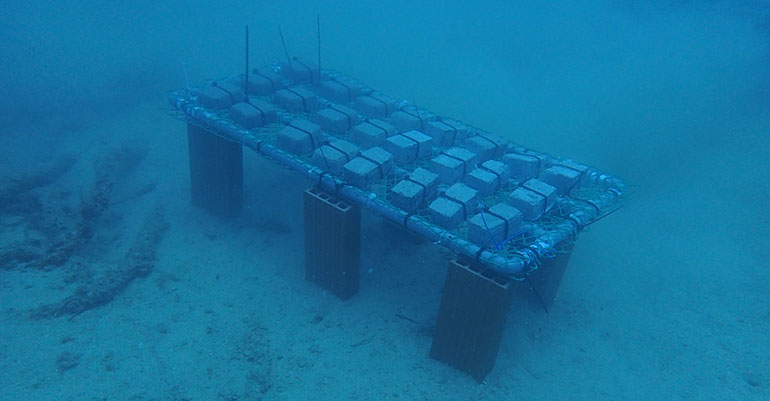
- Design, manufacture and installation of the validation structures, in which a series of test pieces and prototypes will be manufactured with the concrete compositions developed for subsequent monitoring.
- Validation of structures: monitoring. In this phase, the ability to colonize marine life in specimens and prototypes located in real environment will be monitored through monitoring campaigns
Click on the following link to access the full news: