WindCrete
Marine crates based on ultra-high resistance concrete (UHPC) for wind turbines, WindCrete is a R&D project developed during 2019-2020 between the companies Rover Maritime and Ingeomar, supported by IVACE within the Program of R&D Projects in Cooperation with co-financing from the ERDF funds of the Valencia Community 2014-2020. The project ends in October 2020.
The main objective of the project is the development and validation of an ultra-high strength concrete-based port crate in the interior and exterior walls so that it meets the requirements needed to act as a support for wind turbines, which would allow the siting of wind farms in port zones taking advantage of the harbour’s own shelter works.
In ultra-high performance concrete, it will be applied to the interior and exterior walls of the foundation area with higher mechanical requirements, combined with fiber concrete on the floor and conventional concrete in the other elements. This new port crate is intended for shelter dikes or vertical wall docks.
The Windcrete project takes its cue from a previous project, the Windports, and tries to go one step further in the design of foundations for wind turbines by applying a special concrete, in this case the ultra-high strength, to certain elements of the structure.
The project is not completed and no final results and conclusions are available. To date, the development framework of the project has been defined, establishing the site of the wind farm that is the Port of Valencia and carried out the wind power study of this site according to wind conditions. Thanks to them, the type of wind generator was selected and the loads produced by it were calculated.
Initially, several alternatives of foundation platform were proposed, finally selecting a marine drawer of square cells, which has been modeled taking into account the demands produced by the wind turbine and considering its manufacture with conventional concrete and with concrete and ultra-high performance in certain elements.
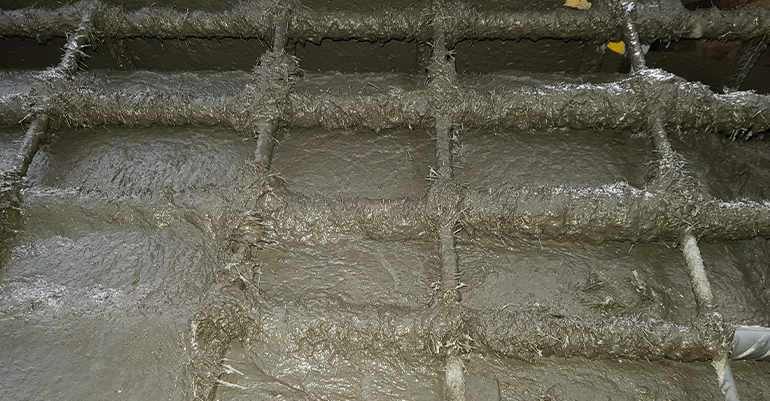
The ultra high performance concrete to be used in the marine crate is characterized by being self-compacting, with a compressive strength of 134 MPa and maximum tensile strength of 9.94 MPa when deformation reaches 4.41%.
Design validation is pending by testing prototype elements representative of the outside wall sections of the drawer.
The Institute of Concrete Technology, ICITECH, of the Polytechnic University of Valencia is also collaborating in the project by carrying out a part of the study on the application of ultra-high performance concrete to maritime crates.