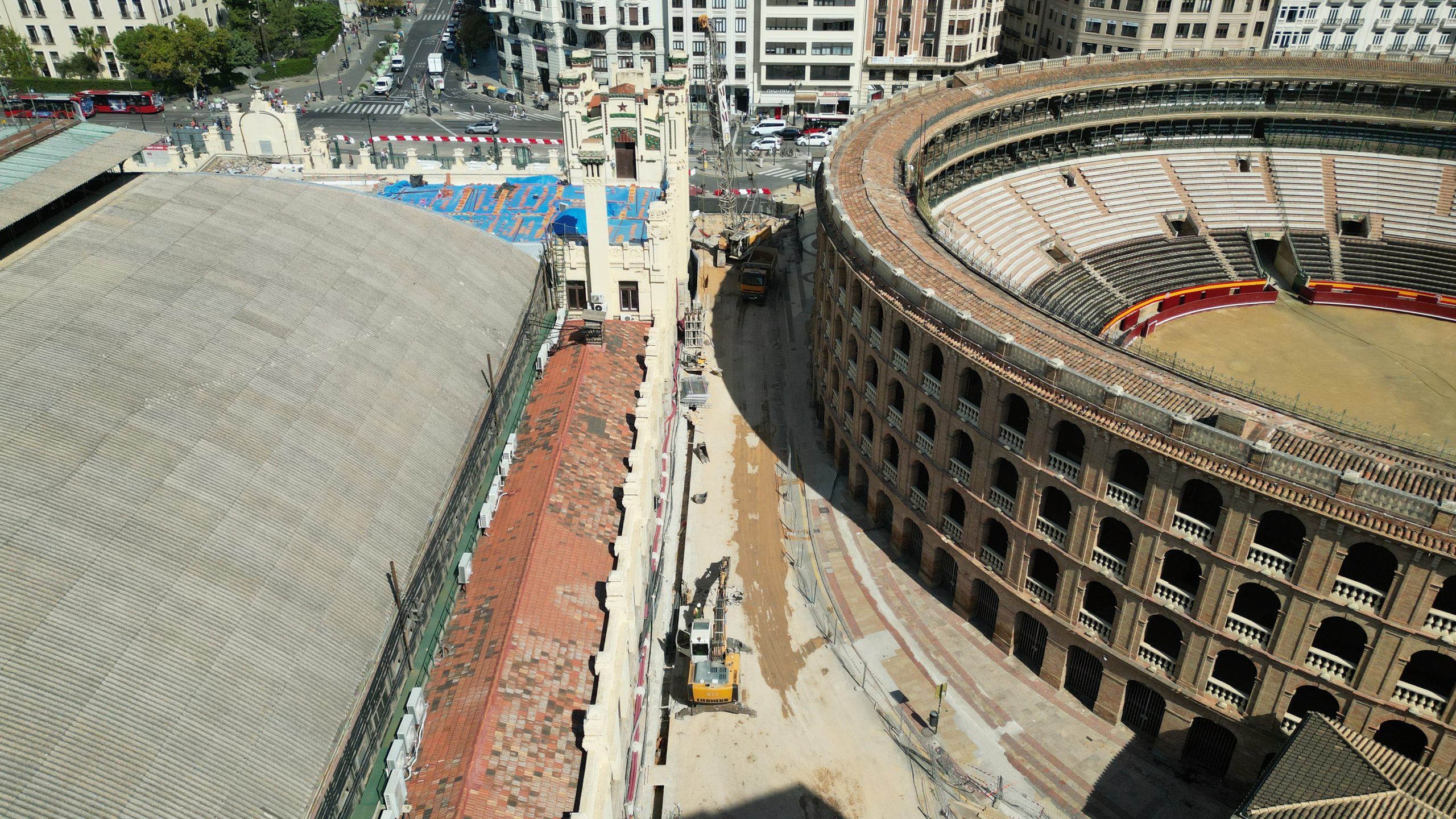
Underground connection between Alicante and Xàtiva stations (Valencia)
This is a pedestrian tunnel connecting the Xàtiva and Alacant stations of the MetroValencia network, thereby linking Line 10 (tram) with Metro Lines 3, 5, and 9. The tunnel has been constructed using diaphragm walls, with slabs cast in situ in reinforced concrete.
The underground connection is approximately 260 meters long and 7.40 meters wide between diaphragm walls. The lower level of the tunnel at Alacant station is aligned with the tram track level, allowing for a future extension of Line 10. To reach this level, excavation between diaphragm walls reaches a depth of 15 meters, placing the base slab below the groundwater table. To make this excavation feasible, a prior jet‑grouting ground improvement treatment was carried out, consisting of mixing the soil with high‑pressure cement grout to form rigid soil‑cement columns and reduce permeability.
The pedestrian level at Alacant station, at concourse level, is built with a slab composed of prefabricated beams and hollow blocks, located 6 meters above the excavation base.
The installations within the pedestrian tunnel have been designed in close coordination with both Alacant and Xàtiva stations. Notably, fire protection systems, including fire curtains, have been implemented. These are programmed to deploy automatically and close off pedestrian access depending on different fire scenarios occurring at Xàtiva station, Alacant station, or within the tunnel itself.
The interior architectural design of the tunnel emphasizes simplicity and brightness, with white and light grey finishes. In particular, four skylight features have been incorporated into the false ceiling, each measuring 1.8 meters in height, 7 meters in length, and 4.5 meters in width. These consist of backlit fabric panels with LED lighting, displaying images of the city and the sky of Valencia.
For the execution of the works, the following equipment and methods were used:
Diaphragm walls constructed using a clamshell grab, forming reinforced concrete retaining structures built in situ below ground level prior to excavation.
Jet grouting, a soil improvement technique that breaks up the ground in situ and mixes it with cement grout at high pressure to create high‑strength, low‑permeability soil‑cement columns.
During the construction process, several key milestones should be highlighted:
- Breakthrough of existing diaphragm walls at Xàtiva station (November 2024) and Alacant station (May 2025), while keeping both stations open to the public
- Reopening to road traffic of the Alicante–Castellón street area at surface level for 9 October 2025, while tunnel works and the second phase of urban redevelopment continued. The reopening took place on 03/10/2025 in the presence of the Regional Minister for Infrastructure
- Redevelopment of the Valencia bullring area completed in 3 months (June–September 2025)
This infrastructure improves connectivity between Line 10 and the MetroValencia network (Lines 3, 5, and 9), significantly reducing transfer times. In addition, the surface redevelopment has enabled:
- The widening of sidewalks along Alicante Street (building side),
Improved paving of the bullring square using rough granite, less slippery than the previous surface, especially in rainy conditions,
And the renewal of utility networks, including the drinking water system on Alicante Street, whose main collector was more than 100 years old.